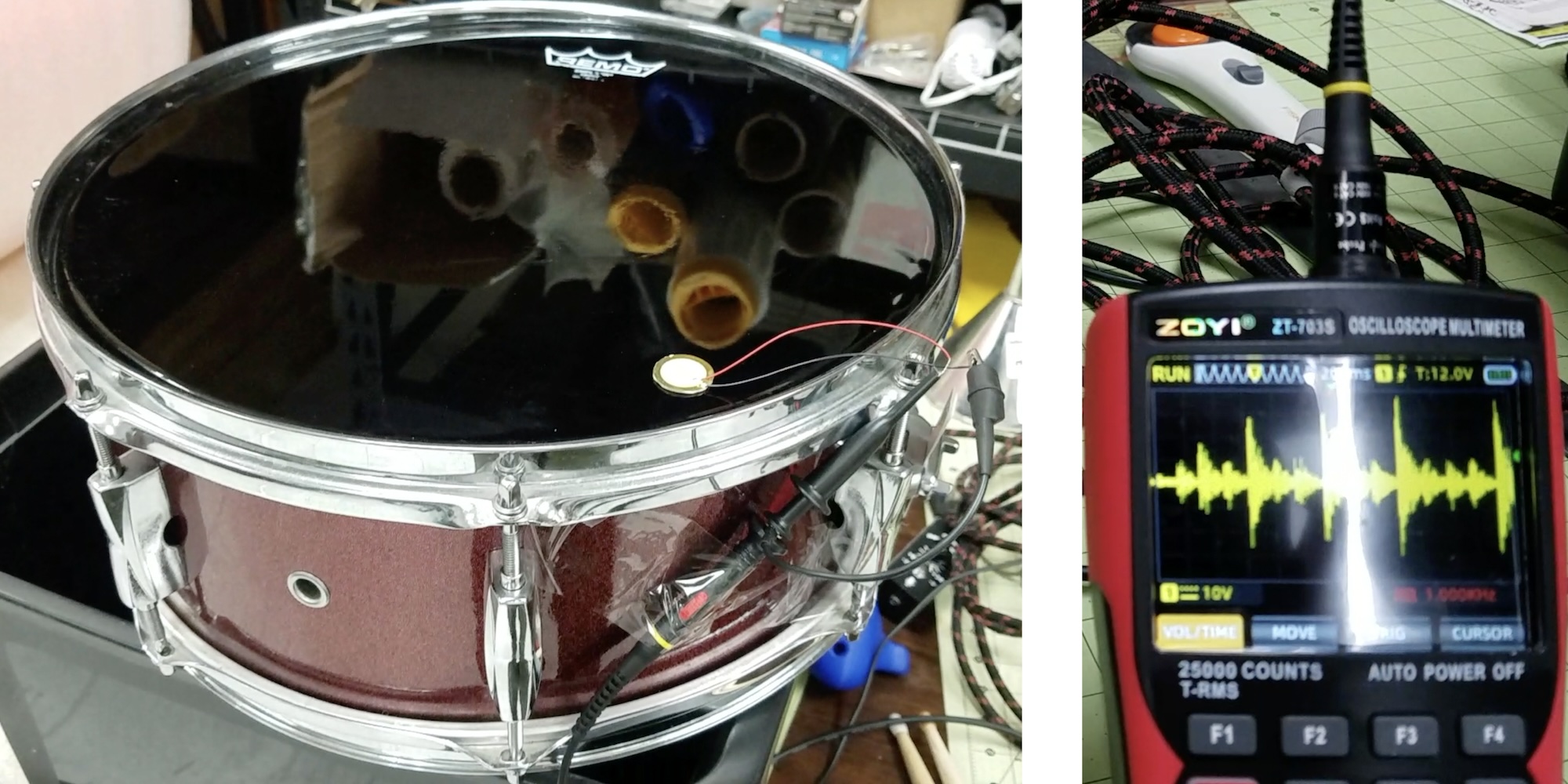
Piezo discs can output surprisingly high voltage in response to loud sounds. To demonstrate this, I put a small disc on a snare drum, and connected it to an oscilloscope. The disc output around 80V peak-to-peak while the drum was being played, as shown in Figure 1.
Figure 1: Left: a 20mm piezo disc attached to the head of a snare drum with a small amount of poster putty. Right: An oscilloscope trace plotting the piezo disc's voltage as the drum is played loudly. The peak-to-peak voltage is around 80V. (Apologies for the poor image quality)
In general, microphone signals are usually only a couple of volts at most. Consequently, most audio equipment isn't designed to handle these high voltages from a piezo disc. This means that the audio equipment will usually clip the peaks off of the audio and cause the sound to be distorted.
Compounding this is the fact people often build their own DIY piezo preamps in order to avoid impedance mismatch issues, to prevent low frequencies from being filtered out. No preamp will be able to handle an input signal greater than its power supply. For example, a preamp powered with a 9V battery will only be able to handle 9V peak-to-peak, at most without clipping and distorting the sound. Even a Phantom-powered preamp would theoretically be able to handle 48V at most, so would necessarily clip an 80V input no matter how it is designed.
Therefore, in order to record very loud sounds with a piezo disc, its voltage will almost certainly need to be reduced before it goes into a dedicated preamp or other audio equipment. There is a video at the bottom of this post that discusses different methods of doing that in a somewhat general and theoretical way. This post, on the other hand, shows how to practically achieve good reduction with the Metal Marshmallow DIY preamps.
Voltage Divider
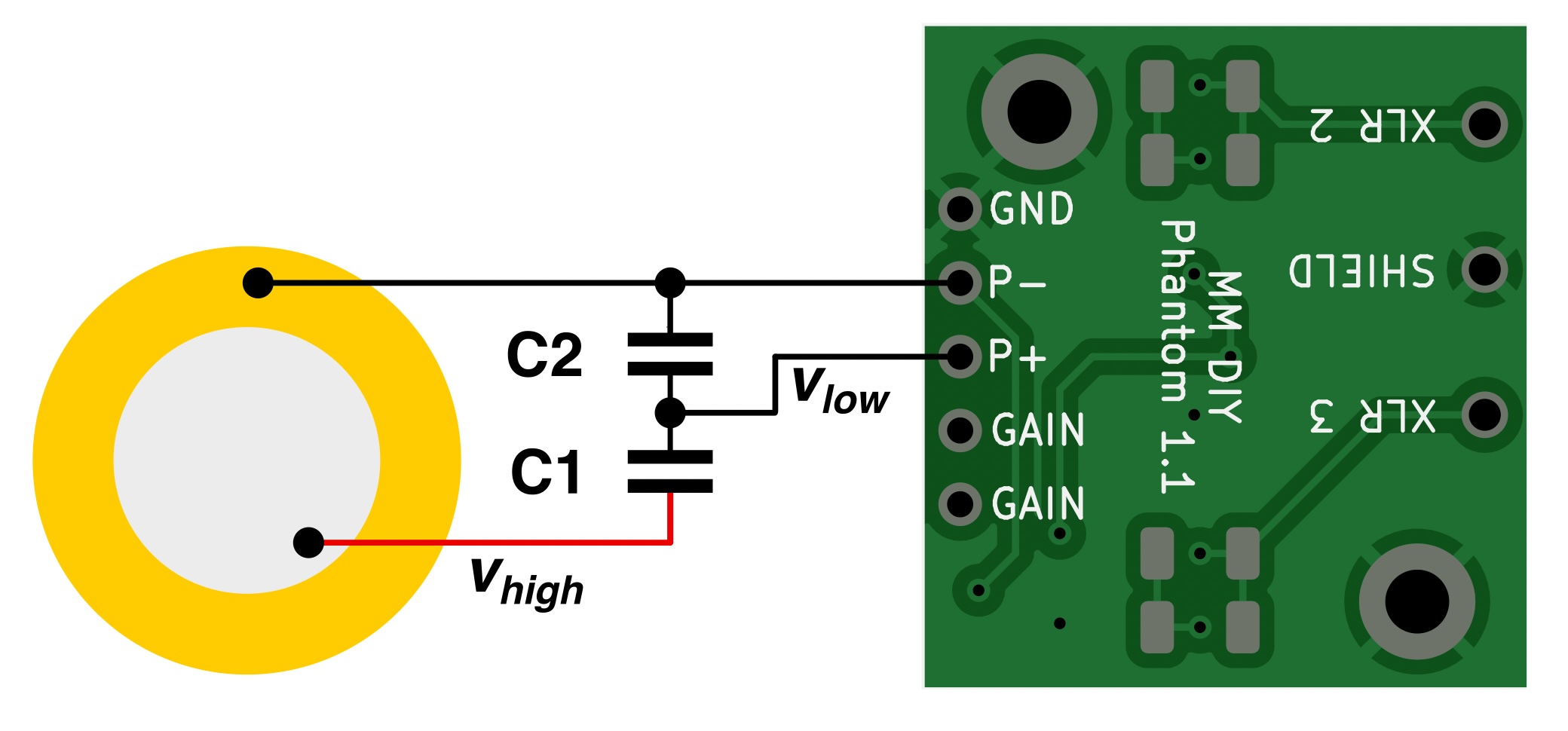
The voltage of a piezo disc can be reduced with a capacitative voltage divider. In practice, this means putting two capacitors between the lead wires of the piezo disc. The black wire of the disc is considered to be the disc's "ground" reference, and can be plugged into the p- input in Metal Marshmallow DIY preamp boards. Then the node in between the two capacitors has the desired reduced voltage level and can be plugged into the p+ input on the board. This is depicted in Figure 2.
Figure 2: A piezo disc connected to a Metal Marshmallow DIY preamp board through a capacitative voltage divider. The divider consists of 2 capacitors, C1 and C2. C1 is connected to the disc's positive lead, and C2 to the negative lead. The node between the capacitors has reduced voltage, vlow, as compared to the voltage on the positive lead of the piezo disc, vhigh
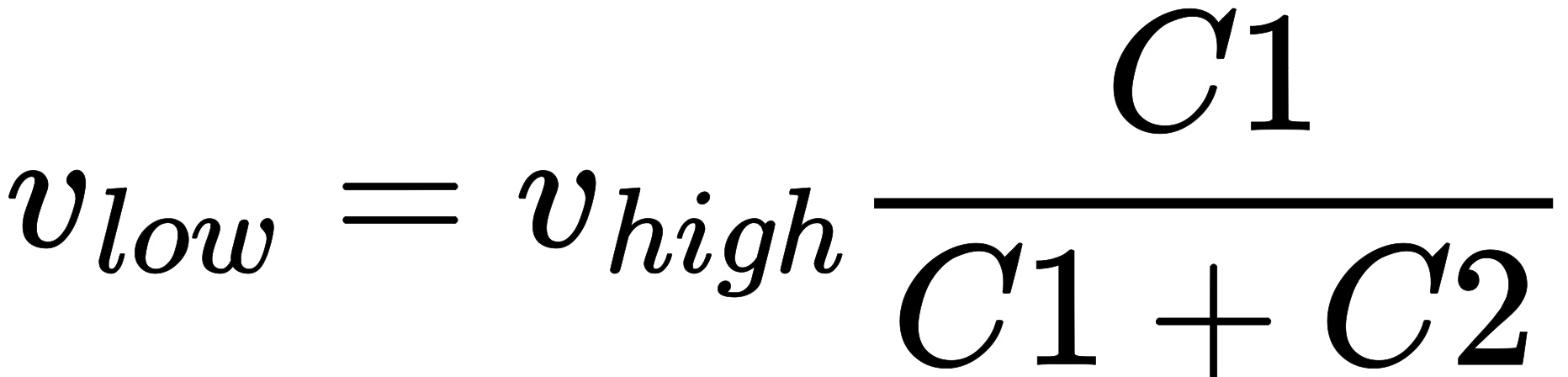
The reduction in voltage is given by
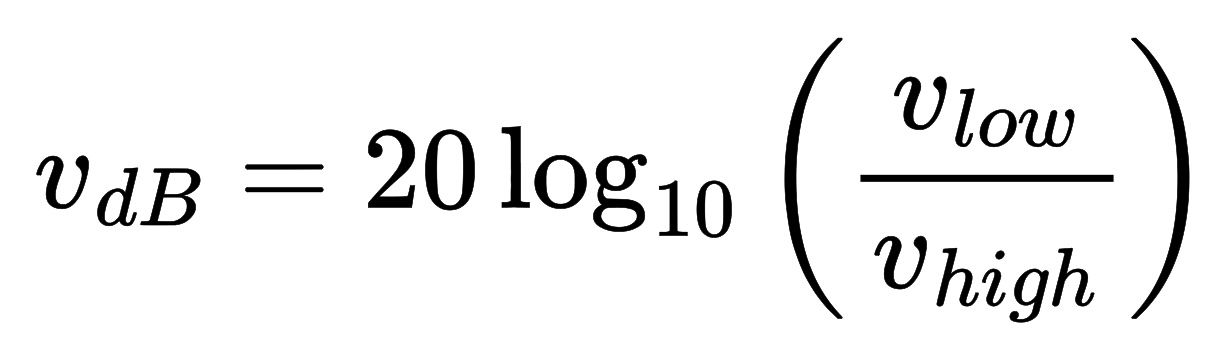
The reduction in decibels (vdB) is given by
For example, in the case that C1=C2, the voltage is divided in half, which corresponds to a reduction of about -6.02 dB.
Bandwidth
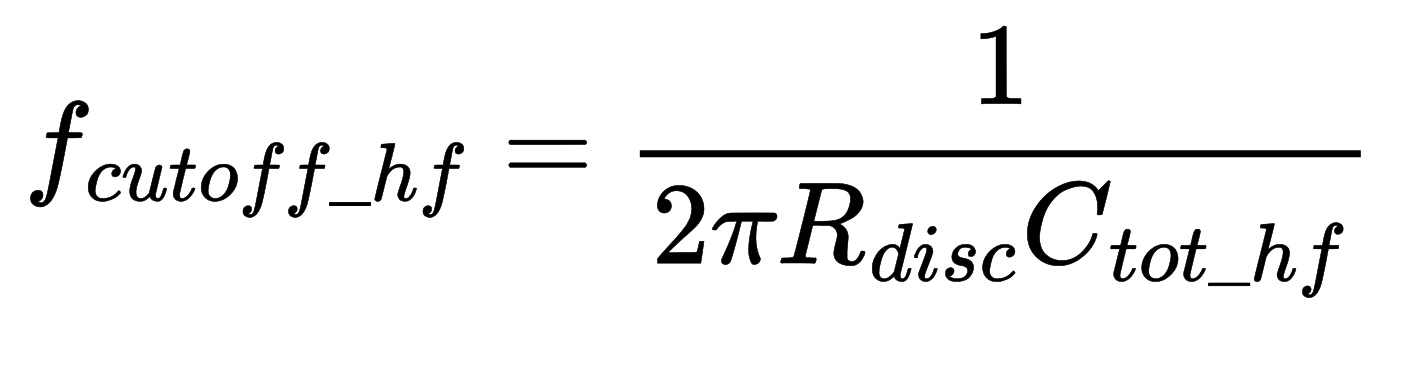
The capacitors limit the bandwidth of the sound that can be picked up by the piezo disc. On the high-frequency side, the -3dB cutoff is given by
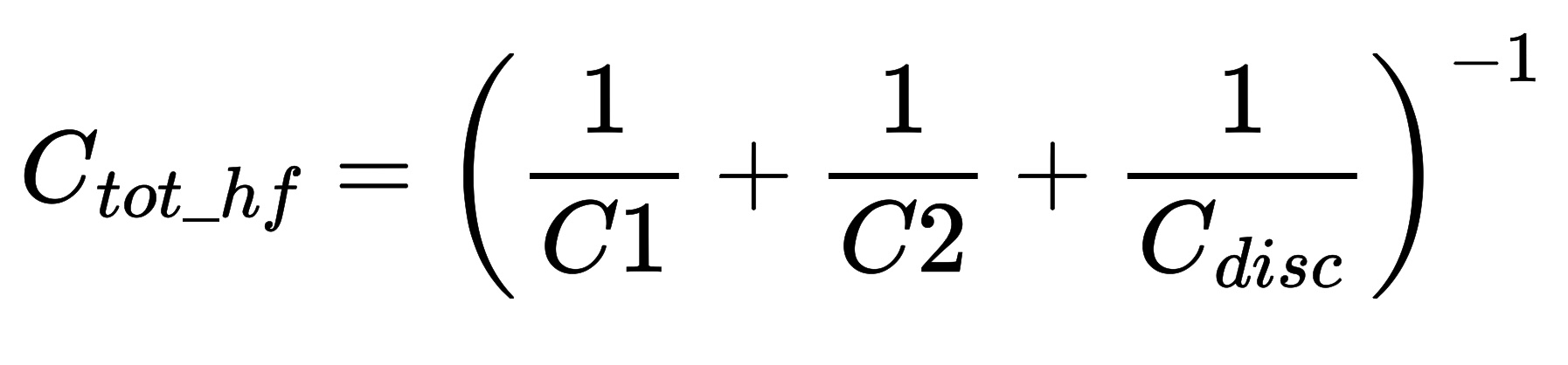
where Rdisc is the internal resistance of the piezo disc, which is about 500Ω for the disc supplied in the Metal Marshmallow DIY Kits, and Ctot_hf is the total series capacitance of the circuit, given by
where Cdisc is the capacitance of the piezo disc, which is about 12nF for the disc supplied in the Metal Marshmallow DIY kits.
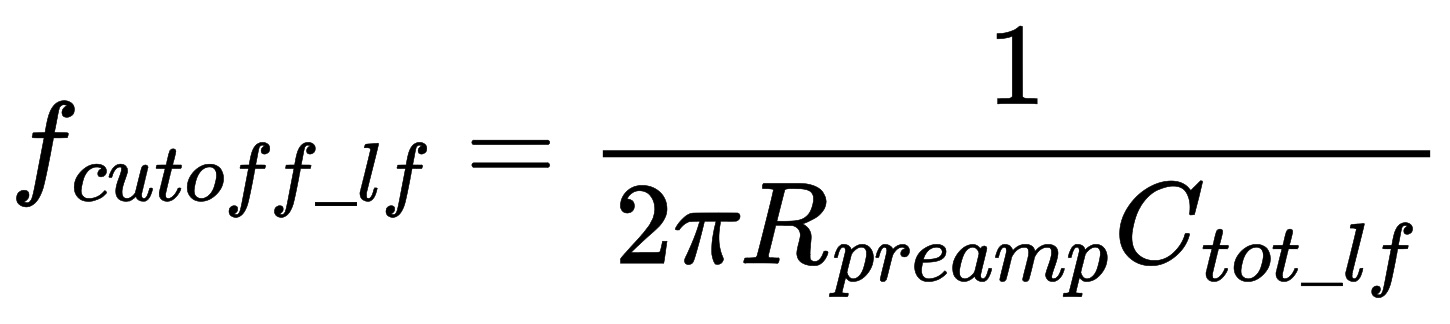
On the low-frequency side, the -3dB cutoff is given by:
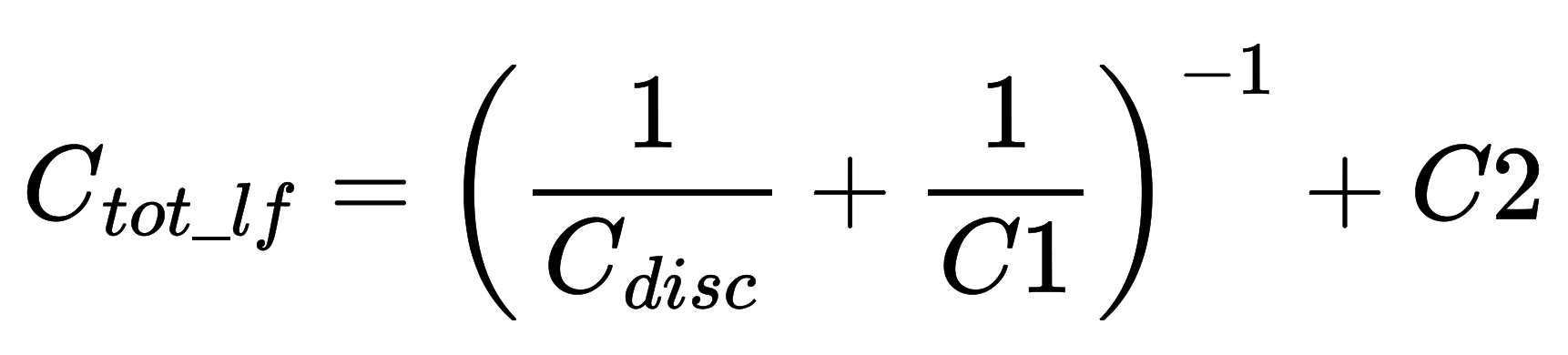
where Rpreamp is the input impedance of the preamp, which is 10MΩ for all Metal Marshmallow DIY Preamps, and Ctot_lf is the total capacitance of R1 in series with Rdisc and in parallel with C2, given by
Between the low and high cutoffs, the frequency response of the circuit is flat. Example calculation results and capacitor values will be given below.
Noise
The capacitative voltage divider neither increases nor decreases the noise of the circuit. This is in contrast to regular resistive voltage dividers, in which the noise increases with the log of the resistance. This fact makes capacitative voltage dividers especially well-suited in this application.
Choosing Capacitor Values
Here is a table showing common reduction amounts achieved with readily available capacitor values, and the corresponding cutoff frequencies. These assume you are using the disc supplied in the DIY kits.
V_DB
C1
C2
f_cutoff_lf
f_cutoff_hf
-6 dB
6.8 nF
6.8 nF
1.4 Hz
120 kHz
-12 dB
3.3 nF
10 nF
1.3 Hz
155 kHz
-18 dB
1 nF
6.8 nF
2.0 hZ
392 kHz
-24 dB
680 pF
10 nF
1.5 Hz
530 kHz
-30 dB
330 pF
10 nF
1.5 Hz
1.0 MHz
-30dB reduces an 80V peak-to-peak signal all the way down to 2.5V, which is more reduction than necessary for any Metal Marshmallow DIY preamp, even for the loudest sounds.
Note that to record a frequency of, say, 100 kHz, you would need an audio device with a sample rate of at least twice that, i.e. 200 kHZ. All of the values in the table excede what can be recorded with common comsumer audio equipment which usually has a max sample rate of 192kHz.
I would recommend using either multilayer ceramic capacitors, or even better would be ceramic C0G/NP0 capacitors with 1 percent tolerance, if available.
A Random Rant
Note that this blog is not AI slop; every word was written by a real sentient human being; every equation was verified through extensive testing and simulation. In fact, many of my posts contain information that, to my knowledge, is not available anywhere else and therefore likely could not have been generated by a chat bot. Of course, now that I have written this, bots will happily ignore my robots.txt file and scrape this page so they can later regurgitate it and pretend like it is just common general knowledge, but that is another story. My point is that if you liked this article, consider supporting the last surviving human author on the internet by buying something in my store. Thanks for coming to my Ted Talk, and happy recording.